
Making Noise Visible: Building the Case for Change in Early Childhood
This month marked an important milestone for the Nuffield-funded Noise project. While much of our recent work has focused on preparing for data collection later this year, we also took an important step in a different direction: bringing together researchers, practitioners, policy specialists, and sector leaders to discuss how we can begin tackling noise in early years environments.
Following our first advisory panel meeting, we hosted a special policy forum at the Nuffield Foundation. Despite London doing its best to make attendance a challenge with tube strikes and travel disruption, around 50 participants joined us for an afternoon of discussion, debate, and collaboration. The event brought together a wide range of perspectives, including nursery leaders, academics, speech and language specialists, acoustic specialists, consultants, policy professionals, sector organisations, and resource providers. The aim was to both discuss the challenges associated with noise, and to explore how emerging evidence might translate into meaningful action across practice, policy, and research. In preparation we developed a short policy briefing document at ISEY which can be accessed here.
The afternoon opened with a welcome from Eleanor Ireland, Programme Head for Education at the Nuffield Foundation, who highlighted the foundation's commitment to improving outcomes for children and young people through evidence-informed research and policy.
The discussions took place against a backdrop of growing concern around children's language development. Recent estimates suggest that around one in six children experience speech, language and communication difficulties, with rates substantially higher amongst children experiencing disadvantage (Speech and Language UK, 2023). Early language development is closely linked to later educational attainment, wellbeing, employment, and participation, making it one of the most important foundations for lifelong development.
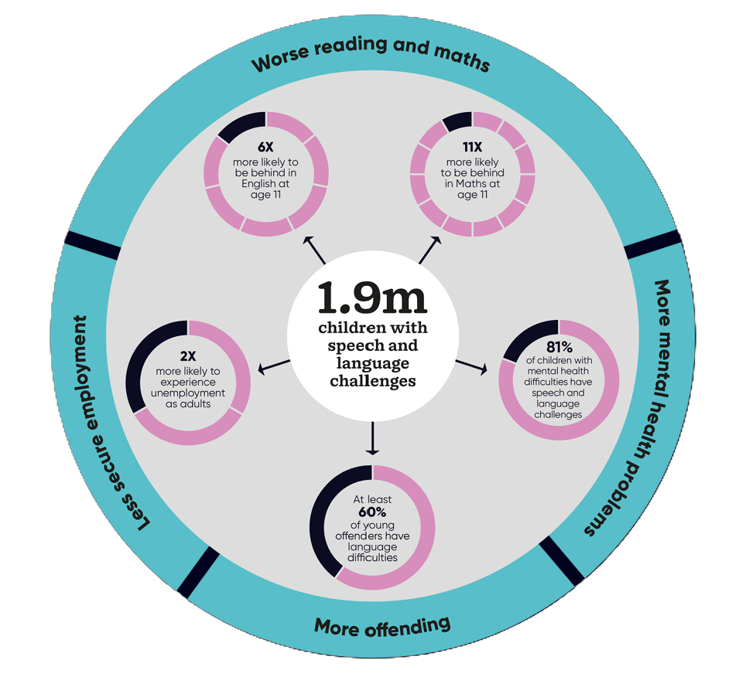
Taken from Listening to unheard children | Speech and Language UK (2023)
Professor Sam Wass then explored what neuroscience and developmental psychology can tell us about noise and why this is relevant now. Research with school-aged children has consistently demonstrated that noisy educational environments are associated with poorer language, literacy, and cognitive outcomes (Klatte et al., 2013). Importantly, these effects appear to be particularly pronounced for children who are already at greater risk of educational disadvantage (Nelson & Soli, 2000).
One of the key themes emerging from Sam's presentation was that while considerable attention has rightly been devoted to practitioner interactions and communication, comparatively little focus has been placed on the environments in which those interactions occur. Children do not learn language in isolation. They learn in busy, dynamic spaces where speech often competes with multiple voices, background noise, and other environmental distractions.
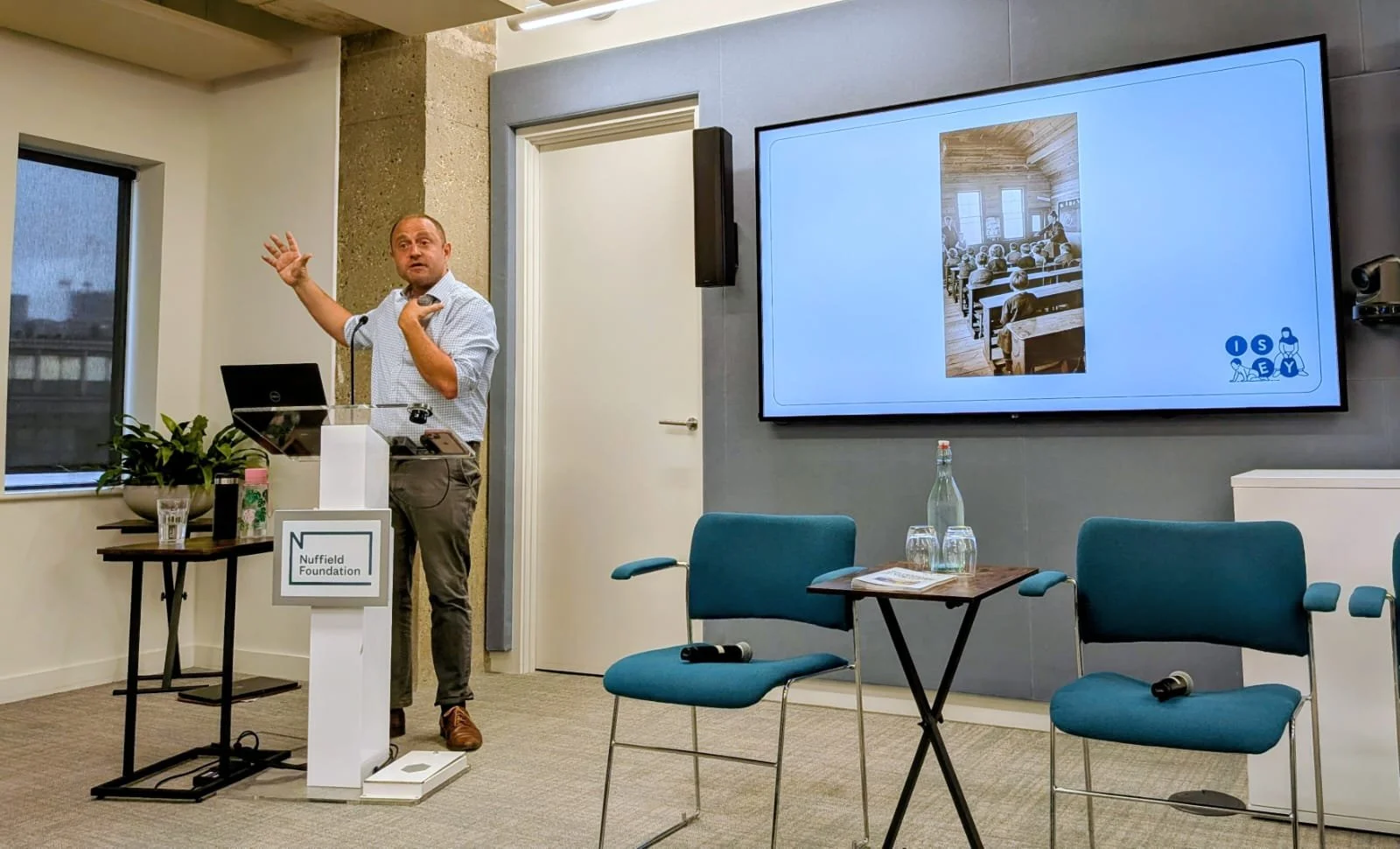
Professor Sam Wass talking at policy event
Dr Gemma Goldenberg then introduced the project and outlined the research programme that will begin later this year. The project (In partnership with the Early Years Alliance) will work with approximately 250 children aged 12 to 30 months across nursery settings in England, investigating how everyday acoustic environments influence children's opportunities to hear, process, and learn language.
While evidence from schools is becoming increasingly well established, considerably less is known about how noise affects younger children during the first years of life. Yet this period represents one of the most rapid phases of language development. Experimental research suggests that infants require substantially clearer listening conditions than adults in order to successfully perceive speech, highlighting the potential importance of the environments in which early language learning takes place (Leibold et al., 2016).
The project will therefore explore both how naturally occurring variation in acoustic environments relates to children's language experiences and whether practical interventions can improve outcomes. These interventions include both environmental acoustic modifications and practitioner communication strategies designed to support language access in noisy environments.
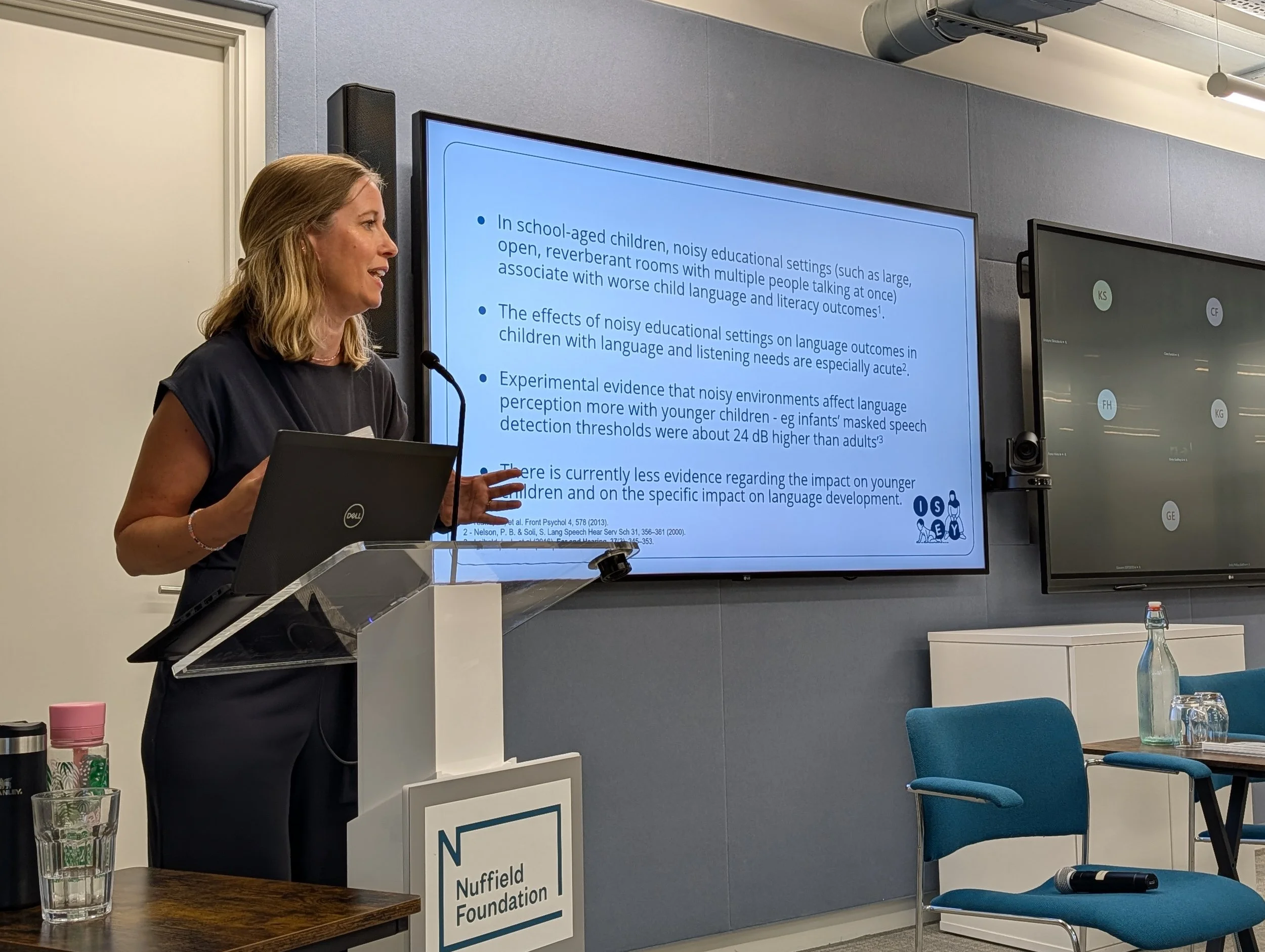
Dr Gemma Goldenberg talking at policy event
What followed was perhaps the most valuable part of the afternoon: a series of discussions bringing together perspectives from across the sector. Representatives from Busy Bees, LEYF, the Early Years Alliance, and other organisations joined academics, practitioners, policy specialists, and speech and language professionals to explore the challenges and opportunities associated with noise in early childhood settings.
The conversation quickly demonstrated that noise cannot be viewed solely as an acoustic issue. Audience questions explored whether some forms of noise may be more disruptive than others, whether children's ability to filter out background noise develops solely with age or through experience, and whether children with SEND or neurodivergent profiles may face additional challenges in noisy environments.
One participant asked whether forest schools might offer part of the solution, noting that outdoor environments may naturally reduce certain forms of acoustic burden. Another highlighted the importance of considering visual clutter alongside auditory noise, arguing that both contribute to cognitive load and children's capacity to focus, communicate, and learn (Something we have been considering in wider lab discussions).
What was particularly interesting to me was the extent to which these questions crossed disciplinary boundaries. The discussion moved between neuroscience, speech and language development, educational practice, environmental design, inclusion, and public policy. It became increasingly clear that noise is rarely experienced as a standalone issue. Instead, it intersects with communication, behaviour, self-regulation, wellbeing, and children's broader learning experiences.
Positively, the conversation quickly shifted from identifying problems towards exploring solutions (Perhaps slightly sooner than anticipated!). Participants shared examples of practical strategies that had already been implemented within their own settings. One contribution from the slido described replacing loud transition announcements with singing. Rather than calling across a room that it was time to tidy up, practitioners began singing a familiar tidy-up song while modelling the activity themselves. Children gradually joined in, creating calmer transitions without the need for raised voices.
Examples like this illustrate an important point. Improving children's listening environments may not always require large-scale structural changes. In some cases, relatively small adjustments to routines, communication practices, or environmental design may have meaningful effects on how children experience and access language throughout the day. Moreover, its possible education professionals have been adapting to noise intuitively for some time now. That is the exciting part of our research, which we hope will discover some of these interesting nuances.
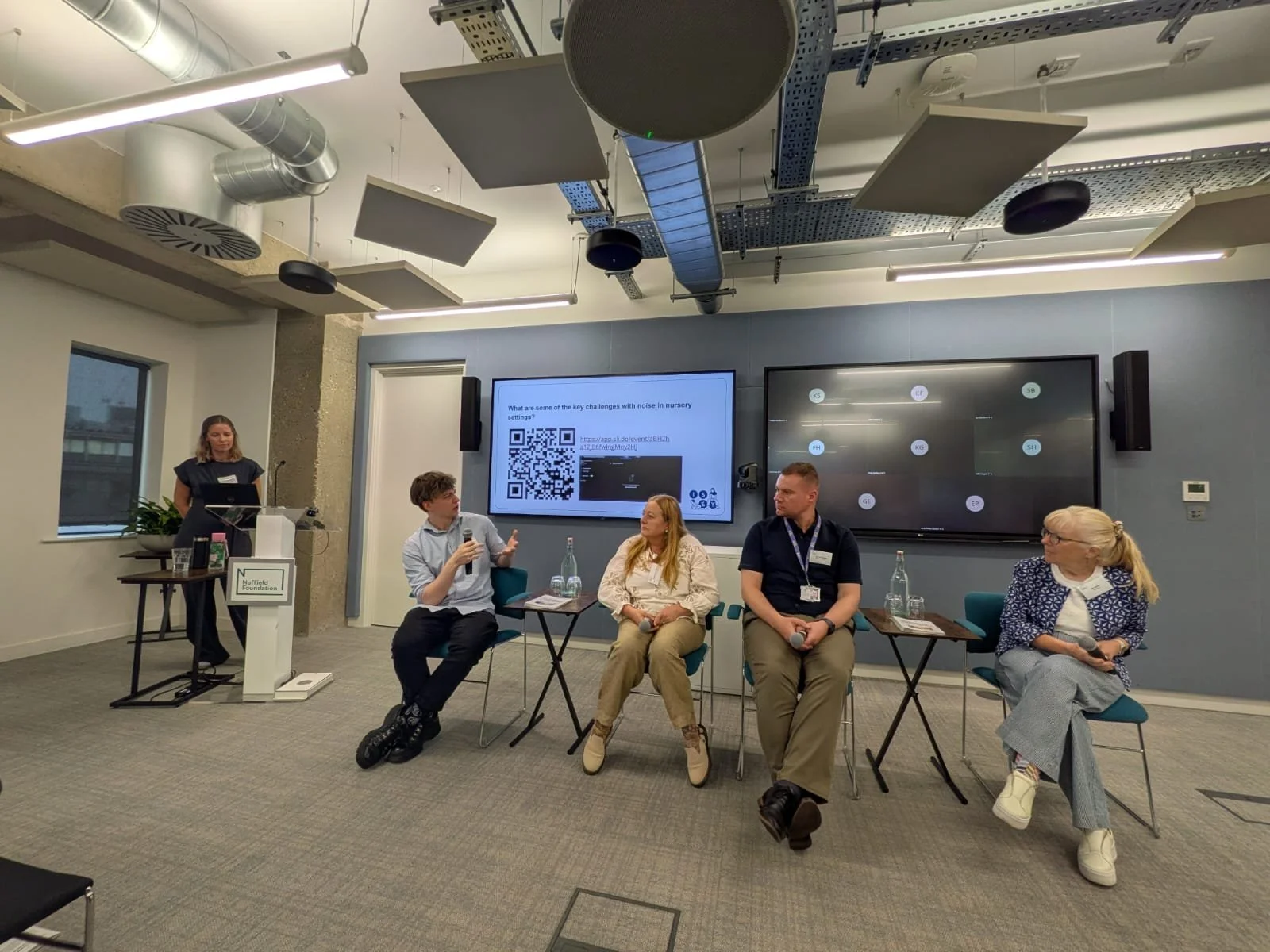
PhD student Conor Bathgate and panellists discuss the challenges of noise in nursery settings
The final part of the afternoon focused on policy implications. One of the strongest themes emerging from the forum was the gap between what we know from research and what is currently reflected within policy and regulatory frameworks. Although acoustic standards exist for many school buildings through Building Bulletin 93, equivalent expectations are largely absent from much of the early years sector.
Given that the majority of early years provision in England is delivered outside maintained schools, this raises important questions about how environmental quality is considered within existing frameworks such as the EYFS and Ofsted inspection arrangements. If environments play an important role in supporting children's communication, learning, and wellbeing, should they receive greater attention within the systems designed to support quality?
The purpose of the forum was not to reach definitive answers. Rather, it was to bring together the expertise needed to ask better questions, identify practical solutions, and begin developing a shared agenda and commitment for change.
As we prepare to attend Evidence Week in Parliament next month to share Dr Gemma Goldenberg's previous research, these discussions will play an important role in shaping both the direction of our research and the policy recommendations that emerge from it. If we are serious about supporting children's language development, we need to extend our thinking beyond what children hear to the environments in which they are listening.
A huge thank you to everyone to took their time to attend the event and contribute their insights. Our research develops best, when it doesn’t develop in isolation.
Further Reading:
Klatte, M., Bergström, K., & Lachmann, T. (2013). Does noise affect learning? A short review on noise effects on cognitive performance in children. Frontiers in Psychology, 4, 578.
Leibold, L. J., Buss, E., Calandruccio, L., Uhler, K. M., & Neff, D. L. (2016). Masked speech perception thresholds in infants, children, and adults. Ear and Hearing, 37(3), 345–353.
Nelson, P. B., & Soli, S. (2000). Acoustical barriers to learning: Children at risk in every classroom. Language, Speech, and Hearing Services in Schools, 31(4), 356–361.
Speech and Language UK. (2023). Listening to unheard children.